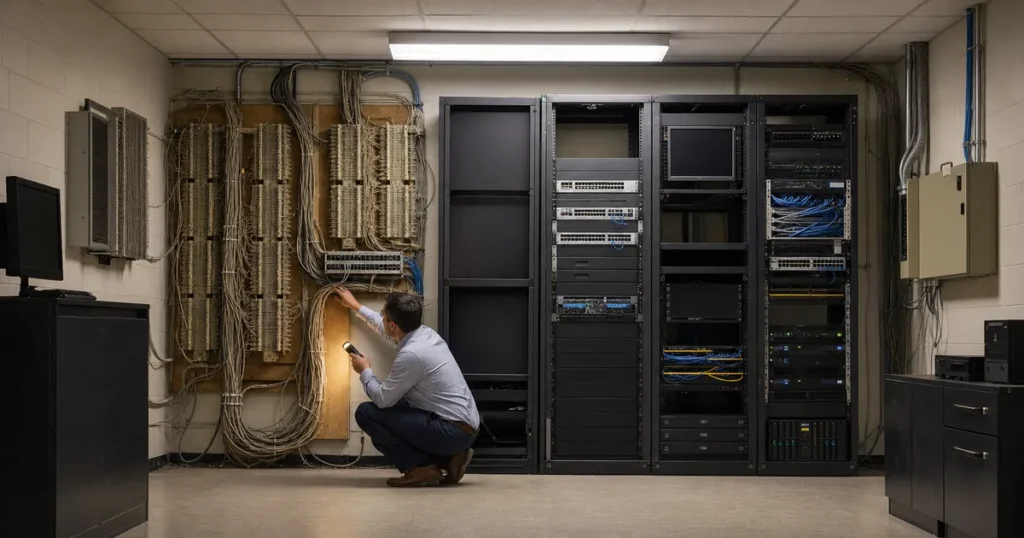
AT&T has stopped treating copper retirement as a future plan. On October 15, 2025, it stopped accepting new orders, moves and changes for many copper-based services across nearly 20 states, and it has told investors it expects to retire copper across the vast majority of its footprint by the end of 2029.
A more recent filing goes further: AT&T is asking the FCC for authority to discontinue legacy TDM-based POTS voice service on or after November 15, 2026, affecting about 90,000 customers across 18 states. That's not a warning anymore. That's a calendar.
In this article
Why copper is disappearing, not just getting more expensive
For years the story on copper was cost. AT&T reportedly spends $6 billion a year maintaining a copper network that only 5% of its customers still use for voice, and that math was never going to hold forever. Copper theft hasn't helped either — it's become enough of a problem that the FBI has named it a threat to critical U.S. infrastructure, and carriers now recover and recycle copper as they take lines down rather than leave it in the ground.
What changed this year is regulation. In March 2026, the FCC removed some of the hurdles that used to slow this down: it eliminated network change disclosure requirements and streamlined the approval process for carriers discontinuing copper-based services. Carriers no longer need to justify a shutdown line by line the way they used to. That's a big part of why AT&T's timeline has accelerated from a stated 2029 goal to active filings affecting specific customers in 2026.
The scale nobody's fully mapped yet
Here's the part that should give any IT or facilities leader pause: nobody has finished counting what's still out there. Ooma's own SVP of corporate development estimates up to 8 million business POTS lines remain in the U.S. — that's before counting residential lines at all. Frost & Sullivan puts the number higher, estimating at least 12 million POTS lines nationwide still need replacing. Nothing we've seen reconciles those two estimates against each other, and that gap itself tells you something: this is a bigger, messier problem than most organizations have mapped for their own footprint, let alone the country's.
The shutdown dates aren't theoretical either. Between AT&T's own 2029 target and the November 2026 filing naming 90,000 customers directly, carriers are pushing real deadlines into 2027 and 2028 for a lot of businesses that haven't started planning.
What a rushed POTS line replacement actually risks missing
This is where most of the pressure in a copper shutdown gets misdirected. The instinct is to ask which replacement technology to buy. The better question is what's actually connected to each of your lines, because POTS lines rarely do just one job. Fusion Connect's guide on replacing these lines points out that a single analog line might be running a fire alarm, an elevator rescue phone, a security system, a fax machine, point-of-sale equipment or a reception desk phone — and a multi-location business may use the exact same line type for completely different purposes from one site to the next.
Fusion Connect recommends a four-phase approach: Assessment, Design & Spec, Site Survey, and Activate. The assessment phase alone asks you to document, for every single line, the phone number, the service provider, the monthly cost, the physical location, the device or system connected to it, who in the business owns that system, and whether the line is life-safety critical. That's a lot of detail to gather under pressure, and it's exactly the detail a rushed cutover skips. Fusion Connect's step-by-step guide walks through this in more depth if you want to see the full framework.
Separately, New Horizon's own breakdown of replacement options makes a related point: fire and security alarms, elevator phones, fax lines and point-of-sale devices don't all have the same requirements, so they don't all belong on the same replacement path. New Horizon lays out what those options actually look like, which is worth a look if you want the vendor's own framing of the choices.
So what should you actually be asking right now
Not "which provider should I switch to." The question that actually matters is simpler and comes first: what is running on each of my copper lines today, and does it still make sense sitting there? Until you know that, no replacement decision — wireless, cable-based, cloud, or anything else — is really an informed one. You're just picking a direction and hoping nothing was missed.
Most IT and facilities haven't had the time to build that inventory. That's not a knock on anyone; it's a side effect of copper quietly doing its job in the background for twenty or thirty years without anyone needing to think about it. The problem is that AT&T's filings don't wait for that inventory to get built. Our page on what to check before your analog lines go dark covers more of what we look for when we start this kind of review.
Get an independent look before a filing makes the decision for you
We sit on your side of the table, not any provider's. A review of your phone and internet bill is where this starts: you tell us what the bill covers and how many locations it includes, one of our advisors reviews your current setup against what's actually available today, and you hear back with what we found and what, if anything, is worth a second look. Nothing moves without you, and there's no pressure toward any provider. It's at no cost to you, and if you've got lines across multiple bills or locations, just tell us how things are set up and your advisor will work with what you share.
Copper isn't going to wait for a quiet year to finish retiring. Better to know what's on your lines now, while you still get to choose the timeline, than to find out when a filing chooses it for you.